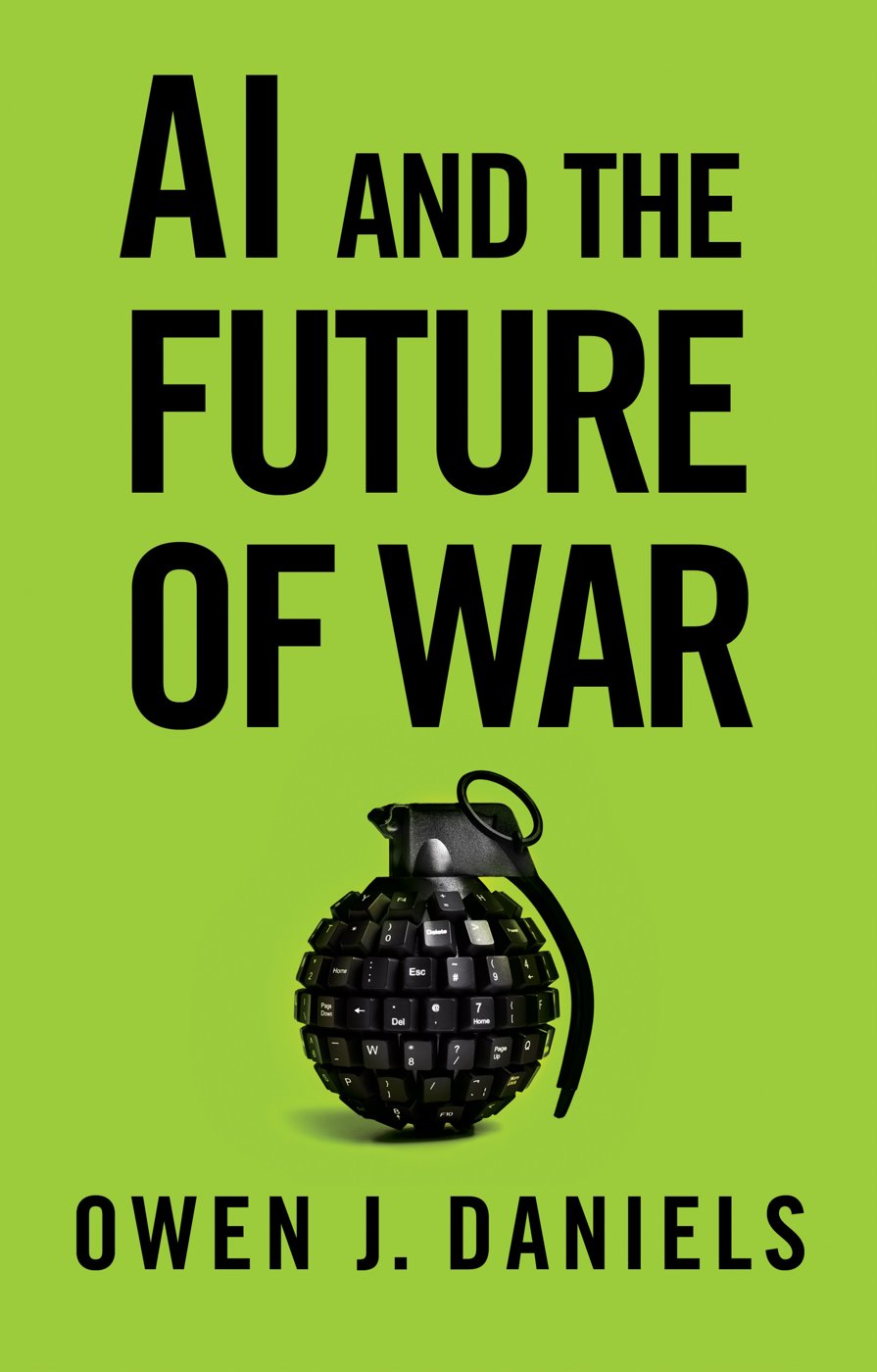
The Book
Unpacking AI's impact on modern warfare
Separating hype from reality in the age of ChatGPT is daunting. As experts decry the disruptive and potentially existential challenge of new AI models, headlines regularly trumpet how AI-enabled systems used in Ukraine and the Middle East or developed for U.S.-China competition are indelibly changing warfare. But AI is not yet revolutionizing warfare, and that isn't necessarily a bad thing.
In this tightly written, compelling book, Owen J. Daniels explores the potential and limits of military AI. He argues that, rather than constituting entirely new ways of war, advancements in artificial intelligence are helping militaries to finally realize long-foreseen uses for the technology, uses that even Cold War technologists incorrectly predicted would reshape warfare in their own era.
The distinction between a military AI which is revolutionary or evolutionary is far from pedantic, Daniels argues. At present, long-standing limitations – from the complexity of human-machine teaming to the difficulty of navigating dynamic battlefields – hinder any fundamental change to the character of warfare.
Global leaders have a narrowing window to shape its trajectory by developing safe, governable AI systems and international understanding around their responsible use. Otherwise, AI could become the threat we all fear.
- Publisher
- Polity
- UK release
- November 27, 2026
- US release
- February 2, 2027
- Hardcover ISBN
- 978-1-5095-6296-1
- Paperback ISBN
- 978-1-5095-6297-8
Praise
Praise for AI and the Future of War
A masterful, historically grounded framework for understanding how AI might transform and even revolutionize military affairs. Daniels cuts through hype and technological determinism, showing how technology, operational concepts, organizations, and human judgment must evolve together, with practical recommendations for military leaders and policymakers.
For those seeking to understand the transformative effect that AI is having on military affairs, this book is a must-read. Drawing on historical context and the current geopolitical climate, Owen Daniels emphasizes the need for thoughtful policy to harness AI's potential while mitigating its most dangerous risks. Daniels examines the revolutionary changes AI's integration across the military enterprise could bring, touching on our competition with China and the challenges created by human–machine integration with the rigor of a leading analyst in the field.
“Owen J. Daniels has written one of the best books available on the evolution of artificial intelligence and its impact on war. It is a study informed by perspectives drawn from the history of technology and the field of military innovation. The result is a rich and measured inter-disciplinary analysis. Highly recommended.”
“This accessible book addresses head-on the debate about whether artificial intelligence is a revolutionary force in military affairs. It counsels a wise approach to military AI, in which people, organisations, politics and strategy are as important as the technologies themselves.”

About the Author
Owen J. Daniels
Owen J. Daniels is the Associate Director of Analysis and an Andrew W. Marshall Fellow at Georgetown's Center for Security and Emerging Technology (CSET), where he leads work on AI governance and supports the Analysis Team portfolio. He is also a Non-Resident Senior Fellow in the Scowcroft Center for Strategy and Security at the Atlantic Council, and serves on the advisory board of the Typology of Research on Artificial Intelligence Lifecycle Security (TRAILS) study at Virginia Tech.
Prior to joining CSET, he worked in the Joint Advanced Warfighting Division at the Institute for Defense Analyses (IDA), where he researched the ethical implications of artificial intelligence and autonomy, autonomous weapons norms, and joint operational concepts, among other issues. He has also worked as an Associate Director in the Atlantic Council's Scowcroft Center for Strategy and Security and as a defense researcher at Aviation Week Magazine. He was a 2022–2023 Penn Kemble Forum Fellow at the National Endowment for Democracy.
Owen attended Princeton University, where he majored in International Relations with minors in Arabic Language and Near Eastern Studies, and he holds a Master's in Public Policy from Georgetown's McCourt School of Public Policy.
Selected Writing & Media
Writing & media
- Oct 2026The Washington PostQuotedJay Clayton's selection to lead the Super Intelligence Force (AI Tech Brief)
- Mar 2026Fox NewsTVAI in the Iran conflict: why humans and AI should team on targeting
- Feb 2026Associated PressQuotedHegseth warns Anthropic to let the military use its AI as it sees fit
- Jul 2025Foreign AffairsEssayChina's Overlooked AI Strategy (with Hanna Dohmen)
- Jul 2025BBC NewsTVCommentary on America's AI Action Plan
- Jul 2024FortuneOp-edThe death of the Chevron doctrine complicates efforts to regulate AI (with Dewey Murdick)
- Sep 2023Foreign AffairsEssayThe Russians Are Getting Better: What Moscow Has Learned in Ukraine (with Margarita Konaev)
- Jun 2023TIMEOp-edThe Perils of China's Great Information Wall (with Dewey Murdick)
- Mar 2023Foreign AffairsEssayAgile Ukraine, Lumbering Russia
- Dec 2022LawfareEssayThe AI “Revolution in Military Affairs”: What Would It Really Look Like?
- Jan 2020War on the RocksEssayDay Zero Ethics for Military AI (with Brian Williams)
Contact
Talks, interviews & media
For speaking invitations, interview requests and review copies, get in touch directly or contact Polity publicity.